10th World Congress of Biomechanics 2026 in Vancouver

POSTDOCTORAL FELLOW in PARIS

Project information:

The “Birdsong for Human(e) voices” project is funded by the CRI and is led by Dr. Pauline Provini. More information on the project: https://projects.cri-paris.org/projects/tY6OqgWS/summary

Job Description Summary:

We are searching for a highly motivated, independent, multidisciplinary postdoctoral researcher to be part of a team focusing on understanding the biomechanics of birdsong. The postdoctoral researcher will play a substantive role in planning and conducting research by using quantitative modelling methods. In close collaboration with the Principal Investigator, the postdoctoral researcher will

  • Participate to the collection of experimental data (multiple X-ray and light high-speed videos, Particle Image Velocimetry data, acoustic data, etc.) of different species of birds during vocalization.
  • Fluid dynamics analysis (CFD model) of bird vocalization.
  • Aero-acoustic modelling of birdsong based on experimental data collected by the team.
  • Draft and publish scientific papers derived from the data.
  • Attend annual scientific meetings to present research derived from the project research.
  • Actively participate to meetings, seminars, and CRI life in general.

Minimum Qualifications:

PhD qualification with relevant research experience in biomechanics (e.g. engineering, modelling) or a closely related field.

Additional positive qualifications:

Specific expertise in one or more of the targeted experimental techniques (PIV, XROMM, and acoustic recordings), experience with live animals, and knowledge of the functional morphology of vertebrates are considered as additional positive elements for the candidate. An interdisciplinary background is highly appreciated.

Typical Hiring Range: Full-Time job ±2200 Euro/month (net) according to the INSERM salary scale.

Location: Centre de Recherche Interdisciplinaire, 8bis Rue Charles V, 75004 Paris France.

Institution information:

The Center for Research and Interdisciplinarity (CRI) experiments and spreads new ways of learning, teaching, conducting research and mobilizing collective intelligence in life, learning and digital sciences. The CRI promotes scientists who thrive in dynamic environments, are inspired and motivated by daily interactions with diverse peers, work best in teams and comfortably mix disciplines, rearranging, straddling field boundaries and wish to explore uncharted domains.

Job Open/Close Date: Fall 2020/ Summer 2022.

Required Documents

To apply for the position, please send the following documents to Pauline.provini@cri-paris.org:

  1. Curriculum Vitae
    1. Cover letter summarizing research interests, professional experience, and career goals.
    1. Names and Contact Information for References

Please have 2 recommendations forwarded directly to Dr. Pauline Provini email address by those individuals providing the references. These should not come from the applicant.

Review of applications will begin on September 15th and continue until the position is filled.

Research Assistant m/f (30 h) Project PrintMyBone @ KL Krems, Austria

The Karl Landsteiner University of Health Sciences (KL) offers a research position for three year (starting Dec. 2019) in the Department of Anatomy and Biomechanics (Division Biomechanics, Head: Univ.-Prof. Dieter Pahr):

Your responsibilities:

  • Participation in the research project “PrintMyBone – 3D printing of artificial bones from clinical CT data”.
  • In particular: use of FDM and SLA printing processes, extension of these printing processes (keywords: “composite materials” and “non-planar slicing”) as well as characterization of 3D printed parts (mechanical testing, micro-CT imaging). The goal is to create 3D printed structures that mimic the mechanical properties of human bones and can be used for precise, repeatable tests for the development of medical devices or for training purposes.
  • Submission of research applications, participation in third-party funded projects
  • Supervision of students and participation in teaching

Your profile:

  • Master degree in biomedical engineering, mechanical or civil engineering, technical physics, material sciences or similar fields
  • handicraft skills and enjoyment of manual laboratory work
  • Basic knowledge of image processing and programming
  • Interest in 3D printing and scientific work
  • Reliable and independent way of working
  • Friendly and team oriented personality

Your Perspektive:

You can expect a challenging job in a highly motivated team with the possibility to achieve the academic degree of a PhD (Dr. techn.)

People with disabilities who meet the required qualification criteria are expressly invited to apply and are given special consideration. The minimum classification is € 2,100 gross per month.

Applications should include a motivation letter, curriculum vitae, and credentials and should be mailed by 17 of November 2019 to Ms. Christina Schwaiger of the Karl Landsteiner University of Health Sciences, Dr.-Karl-Dorrek-Straße 30, 3500 Krems, Austria (bewerbung@kl.ac.at).

Vacancy Editor @ Taylor & Francis: Computer Methods in Biomechanics and Biomedical Engineering

Group-logo-blue

Would you like to be the Editor of Computer Methods in Biomechanics and Biomedical Engineering (CMBBE)?

We are looking for a new Editor/Editorial Team to lead the editorial board of CMBBE. Applicants should have an academic background in biomechanics and biomedical engineering, specifically a high level of multidisciplinary knowledge across the fields of computational biomechanics, biomedical applications and numerical methods, as well as the passion to drive the journal forward. 

The successful candidate(s) will be responsible for editorial oversight and decision-making on submissions. They will have authority to accept articles following successful peer review and will ensure that reviewers and authors adhere to the Journal’s Code of Publishing Ethics. For more information on the role of a journal editor, please click here.

Becoming the editor of a journal is a rewarding and fulfilling experience where you will extend your own networks, promote the research that you are passionate about, increase visibility of your own research and be recognized as a leading figure within the academic community. 

Interested in applying? Here are the skills and attributes we would be looking for in a successful applicant:

·       Someone who is active in the community with strong personal networks

  • Confidence to engage with authors and researchers to solicit the highest quality submissions
  • Strong organizational skills to ensure that submissions are handled in a timely manner
  • The ability to foster positive working relationships with colleagues in the Editorial Board
  • This position may be available as a co-editorship – please note your interest in this in your application.

Submitting your Application

If you would like to apply for the position please forward your CV to Ishtiaque Shams, Portfolio Manager, at Ishtiaque.Shams@tandf.co.uk

Deadline for application is 31 October 2019.CMBBE is a leading Journal in the field with the aim to provide a means of communicating the advances being made in the area of computational biomechanics and biomedical engineering with the emphasis being placed on biomechanics. For more formation about the Journal please click here.

Call for Bids hosting ESB 2023

The ESB invites proposals for the organization of its annual congress in 2023. If you would like to host and organize the 2023 ESB congress and wish to prepare and submit a bid, please read the conference rules.

Interested members can contact or send a proposal/bid to Prof. David Mitton, Chair of the Meetings Committee (david.mitton(at)ifsttar.fr),

The deadline for bid submission (first step) to organize the ESB 2023 is 15 December 2019.

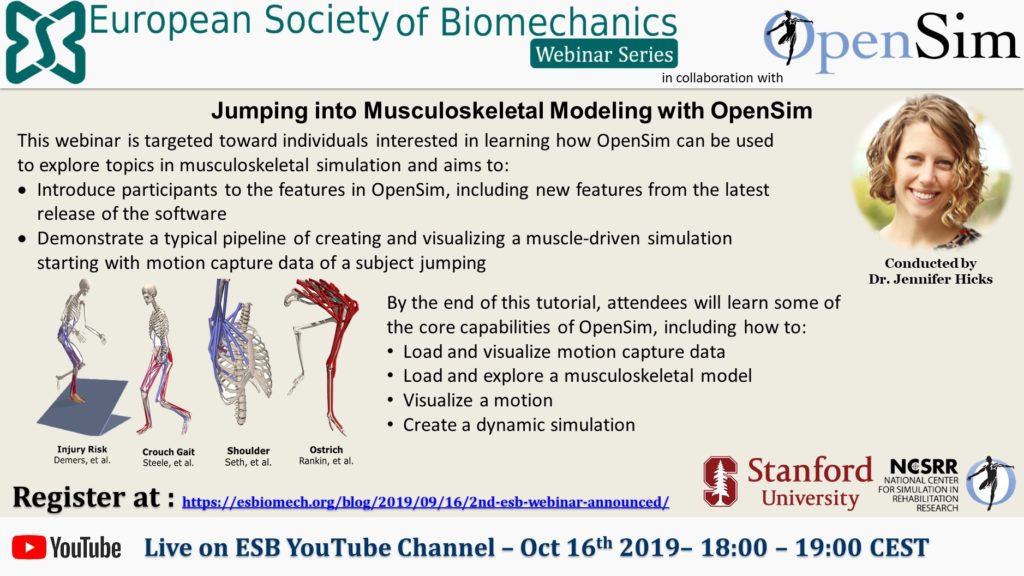
2nd ESB Webinar Announced: OpenSim

Jumping into Musculoskeletal Modeling with OpenSim

We are delighted to announce the second webinar of the ESB Webinar Series which will introduce the OpenSim Software. The webinar will take place on October 16th 2019 at 18:00 CEST.

OpenSim is a freely-available, open-source musculoskeletal simulation software for visualizing and simulating movement. Musculoskeletal modeling and simulation are powerful tools to help understand the complex interactions between the neuromuscular and skeletal systems during movement.

This webinar aims to:

  • Introduce the main capabilities of OpenSim, including new features from the latest release of the software
  • Demonstrate a typical pipeline of creating and visualizing a muscle-driven simulation starting with motion capture data of a subject jumping

By the end of this tutorial, attendees will learn some of the core capabilities of OpenSim, including how to:

  • Load and visualize motion capture data
  • Load and explore a musculoskeletal model
  • Visualize a motion
  • Create a dynamic simulation.

The webinar will be conducted by Dr. Jennifer Hicks. Dr. Hicks is Associate Director the National Center for Simulation in Rehabilitation Research, an NIH-funded center at Stanford University that brings state-of-the-art engineering tools to rehabilitation scientists. In addition, she is the Research and Development Manager of the OpenSim software project, guiding the project’s development team and serving as the voice of the software user/researcher.

The seminar will last 45 minutes followed by 15 minutes of Q/A from the audience. You will have the chance to ask your questions which will be addressed by the speaker at the end of the webinar. However, it would be great if you could send your question in advance while filling the registration form or by sending to Ehsan.soodmand@charite.de and/or rodrigo.romarowski@grupposandonato.it  before the start of the webinar.


Click here to register for the webinar.


October 16th 2019 18:00 CEST

Live on ESB YouTube Channel – Please Subscribe! (https://www.youtube.com/esbiomech )

Looking forward to your attendance.

ESB Student Committee

Fully funded PhD studentship @Nottingham

The link to the position advertisement is  http://jobs.nottingham.ac.uk/ENG1305 .

Applications are invited for an exciting fully-funded PhD studentship in the Bioengineering Research Group, Faculty of Engineering at the University of Nottingham.

Research area. The research topic focuses on developing solutions that enable in-natura markerless motion capture for biomechanical modelling in Biomedical and Sports Engineering. Specifically, it addresses the fundamental research problem of reconstruction of person-specific human pose, kinematics, and surface geometry to enhance our understanding of the non-linear behaviour of human motion, musculoskeletal injury and disease and enable modelling of soft-tissue dynamics. Open problems in human-object interaction and tracking will also be explored.

The project. The candidate is expected to develop a fast and robust method for inferring and tracking 3D shapes of deformable objects, humans in particular. The method will be mainly based on visual sensing. Inertial and force sensors will be used as complementary sensing. The method can use either or both of model-based and learning-based approaches, such as CNN based segmentation, geometric CNNs, or convolutional kernel filter based tracking. The candidate will have access to a newly established state-of-the-art integrated motion capture laboratory.

The candidate. The ideal candidate will have;

  1. a first or upper second class honours or Masters degree in Electrical and Electronic Engineering, Physics, Computer Science or other relevant and equivalent degree from a quality recognised institution.
  2. a solid background in mathematics and excellent analytical and numerical skills, as well as problem solving skills
  3. strong background in 3D computer vision, pose estimation, shape reconstruction, structure from motion, segmentation, or object detection.
  4. experience in image or video processing and digital signal processing.
  5. strong programming skills in Matlab, C/C++, or Python. Previous hands-on experience with deep learning platforms and agile software development as well as experience of working within industry will be an advantage.
  6. very good written and communication skills and fluency in English.
  7. a driven, independent professional and self-reliant work attitude within a fast-paced & collaborative environment.

Informal enquiries about the project may be addressed to Dr Ami Drory. Please (i) insert your cover letter, CV and copies of academic transcripts into a single pdf file. (ii) Name the file with your name as ”firstName_lastName_phd”. (iii) e-mail to: Ami.Drory@nottingham.ac.uk, with [3D shape reconstruction PhD application – lastName] as the email subject.

Application instructions. Formal applications are to be made via http://www.nottingham.ac.uk/pgstudy/apply/applyonline.aspx

Closing date for applications. Review of applications will commence on 15 October 2019 and remain open until filled. A start date is expected to be as soon as practical thereafter.

The University. The University of Nottingham is a world-class University consistently ranked among the world’s top 100 universities. It is a Russell Group university and a member of Universitas 21 (U21), the global network of research-intensive universities. The University is ranked eighth in the UK on ‘research power’ in the latest REF rankings. The Faculty of Engineering is ranked in the top 10 in the UK with more than 98 per cent of its research ranked of international quality, with 85 per cent graded as ‘world-leading’ or ‘internationally excellent’.

The university was awarded the University of the Year for both International and Sports in the 2019 Guide. With award-winning campuses, University Park is The University of Nottingham’s largest campus at 300 acres. The campus is widely regarded as one of the largest and most attractive in the UK. Set in extensive greenery and around a lake, University Park campus has consistently won a Green Flag Award for its green and environmentally friendly spaces every year since 2003. The University of Nottingham was ranked the World’s second greenest university in 2019 (GreenMetric). The brand new £40 million David Ross Sports Village is now open, offering an inspirational and accessible sports provision for all.

PhD studentship at Insigneo Institute (University of Sheffield):

A stochastic finite-element model for predicting changes in bone strength

Closing date 22/09/2019

Employer: The University of Sheffield (Department of Mechanical Engineering)

Location: Sheffield, UK

Description

Are you a bright, enthusiastic and self-motivated student interested in a PhD in biomechanics? An exciting multidisciplinary PhD opportunity is now available at the Insigneo Institute for in silico Medicine at the University of Sheffield, UK.

Pharmacological interventions that target improvement in bone strength typically seek to improve bone morphology (geometry). Yet, a model to predict change in strength, given knowledge of bone morphology changes, has not received much attention. The recently awarded project MultiSim2 (supported by the EPSRC, UK) will engage with this ageing-related challenge.

Changes in tibia geometry appear at distinct scales (doi: 10.1371/journal.pone.0219404)

Previously in MultiSim, in vivo micro-computed tomography enabled quantification of bone geometry changes in small animals (e.g. mice) with unprecedented spatial and temporal detail. The PhD student will use this information to:

  • Capture bone geometry changes driven by cellular processes using Gaussian Process emulators;
  • Implement a stochastic finite-element (sFE) model to predict bone strength changes in response to emulator parameters;
  • Analyse the global sensitivity and uncertainty propagation of the sFE model.

The expected start date for this project is December 2019.

About the University of Sheffield
The University of Sheffield is a Russell Group university, which represents the 24 leading UK universities committed to maintaining outstanding research and teaching environments. The University of Sheffield regularly ranks among the top 10 in the UK in terms of research output. In addition to having a long tradition of world-class engineering research, Sheffield benefits from geographical proximity to the industrial cities of Manchester, Liverpool and Leeds.

The ambition of the Insigneo Institute is to achieve a transformational impact on healthcare. As such, it possesses extensive experience in the development of computer simulations aimed at better understanding of the biomechanics of the musculoskeletal system. This project will be co-supervised by Dr Pinaki Bhattacharya, Dr Enrico Dall’Ara and Prof Visakan Kadirkamanathan. It will benefit as well from the multidisciplinarity of MultiSim2 research.

Candidate Profile
The successful candidate should have or be expected to obtain an excellent degree in mechanical engineering, bioengineering, computer science, physics, applied mathematics or a related discipline. Experience in finite-element analysis and in programming languages (e.g. C, C++, Matlab, Python) are essential. Exposure to high-performance computing is desirable.

Funding and Duration
A 3.5 year studentship, co-funded by the Departments of Mechanical Engineering, Oncology and Metabolism and Automatic Control and Systems Engineering, is available for UK and EU applicants. The studentship covers the cost of tuition fees and provides an annual tax-free stipend at the standard UK research rate.

How to apply?

To apply please use our standard on-line PhD application form and indicate on your form that you are replying to this advert or email me-pgadmit@sheffield.ac.uk for further guidance on applying.

Contact details

For further information about this project, please contact Dr Pinaki BhattacharyaDr Enrico Dall’Ara or Prof. Visakan Kadirkamanathan with “BONEsFE PhD studentship” in the title.

PhD position @ Julius Wolff Institute (Berlin) : COMPUTER OPTIMIZATION OF SCAFFOLDS FOR BONE REGENERATION

A PhD position is available within the Computational Mechanobiology Group at the Julius Wolff Institute (Charite Medical School in Berlin) on the topic of computational optimization of scaffolds to promote bone regeneration within large bone defects. 

Background

Although bone has the fascinating ability to self-regenerate after injury, large bone defects often lead to delayed or non-unions. The treatment of these conditions remains a clinical challenge for which scaffold-based strategies appear as a promising approach. In this approach, 3D open porous structures are implanted in the bone defect with the aim to support bone regeneration. Although, preliminary pre-and clinical data show encouraging results, there is still a need to optimize these scaffolds to ensure successful healing. The growth of new bone within the scaffold is influenced by many factors, such as the scaffold architecture, material properties, patient health condition, etc. The aim of this project is to investigate the potential optimization of scaffolds to promote bone regeneration within large bone defects.

Tasks

You will develop computer models to simulate the bone healing process and the interaction between mechanical signals (strains) within the healing region and biological processes (e.g. cellular migration, matrix deposition, etc.) taking place. You will simulate the interaction of the bone regeneration process with scaffold-support structures and develop algorithms for the computer optimization of the scaffold design to promote the bone healing process. You will be able to compare model predictions with experimental data from animal studies (e.g. histology, microCT) and to have access to patient data. The project is part of a research collaboration between several Institutes on the topic of “Personalised Bone Defect Treatment” (Funded by the BMBF).

Your profile

  • A degree in Mechanical Engineering/Computer Science/Mathematical Biology or a related discipline
  • Knowledge of Finite Element Modelling will be advantageous
  • Experience in Programming is required (e.g. C/C++, Matlab)
  • High motivation and strong interest in research

What we provide

This position is available for a period of three years. Salary will be commensurate with experience. You will work in a friendly team and in a unique research environment. As a PhD student you will be associated to the Berlin-Brandenburg School of Regenerative Therapies (www.bsrt.de) and benefit from the interaction with international students. Starting date: 1st October, 2019.

Apply
Interested candidates should send a CV, a cover letter and two references that could be contacted. Please email the application to Prof. Checa via email at: sara.checa@charite.de

Two Post-Doc and/or post-graduate Research Assistant positions at Università Campus Biomedico di Roma.

In the context of several National and International Grants, we are seeking two outstanding Post-Doc researchers and/or motivated post-graduate Research Assistants to join us in developing new wearable devices, systems, and data analysis tools for physiological and physical activities monitoring.

The ideal candidate should have the following expertise:
– Relevant publications in international journals and experience in fundraising
– Fluent English is essential
– Excellent interpersonal skills including team working and a collegiate approach. Self-motivation, initiative, and independent thought/working.
– Proficient in MATLAB, Python, C, C++ programming
– Experience in one or more of the following topics:

1. Wearable systems design and development, encompassing electronic design, assembly and testing, microcontroller-based programming.
2. Body Sensor Networks
3. Real-time data acquisition and processing and related algorithms
4. Experimental protocols on human subjects

We will appreciate if you could send your interest to apply by email to E. Schena (e.schena(AT)unicampus.it), D. Formica (d.formica(AT)unicampus.it) and C. Massaroni (c.massaroni(AT)unicampus.it), including a motivation letter detailing how your research profile relate to the project and a CV.


Corporate members of the ESB:

AMTI force and motion logo
BERTEC logo
Beta CAE logo
Materialise logo
Nobel Biocare logo